
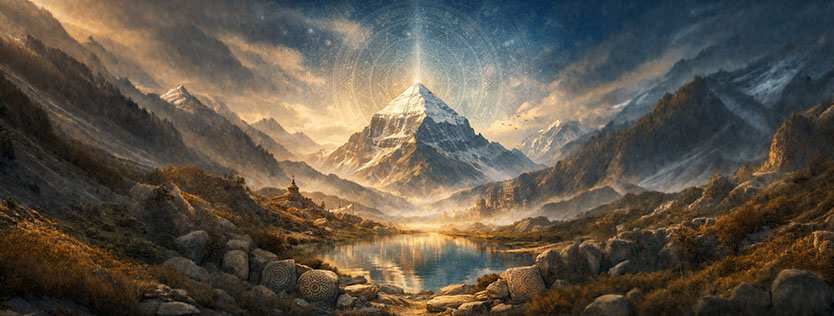
Mount Kailash and the Hidden Geography of Power
There are many sacred places in the world, but few are treated with the same level of reverence as Mount Kailash. It is not simply admired—it is left alone. No verified ascent has ever reached its summit. Attempts have been discouraged, denied, or abandoned. Pilgrims do not climb it—they walk around it, tracing a ritual path known as the kora, circling the mountain in devotion.
To modern eyes, this may seem unusual. Mountains are meant to be conquered, explored, documented. But Kailash exists outside of that mindset. It is not approached as an object to be mastered, but as a presence to be respected.
At first glance, Kailash appears natural. Yet the more closely it is observed, the more it invites scrutiny. Its slopes are unusually smooth. Its faces align in ways that seem almost geometric. The north face, in particular, has drawn attention for its striking symmetry, resembling a vast, weathered pyramid.
In a world where ancient civilizations constructed precise geometric monuments—from the pyramids of Egypt to the stepped temples of Mesoamerica—such symmetry is often associated with intention. This does not mean Kailash is artificial. But it does invite a deeper question:
Why does this mountain appear so structured, so distinct from its surroundings?
Some researchers have suggested that rather than being constructed, certain natural formations may have been recognized and utilized by ancient civilizations. Instead of building from scratch, they may have worked with the Earth itself—selecting locations where natural forces were already concentrated. In this light, Kailash becomes something else entirely: not a creation, but a focal point.
Modern civilization tends to view the Earth as a collection of resources—minerals, land, water. But what if earlier cultures saw it differently? What if they understood the planet as a dynamic system, alive with forces that could be observed, harnessed, and perhaps even directed?
There are theories—often dismissed, yet persistently revisited—that ancient civilizations possessed a deeper awareness of natural energy systems. Not electricity in the modern sense, but something more fundamental: the interaction between geology, magnetism, and the environment.
Mountains rich in crystalline structures, such as granite, contain quartz—a mineral known today for its role in oscillation and energy regulation in modern technology. Quartz is used in watches, radios, and communication devices because of its ability to maintain stable frequencies when energized.
The question is: Are certain places on Earth naturally predisposed to become centers of power, influence, and human concentration?
Let’s take a look at some places on our planet that share energetic elements as primary sources of power. The one that immediately comes to mind is Manhattan Island in New York City. Few places on Earth rival its density of ambition, creativity, commerce, architecture, and cultural output. Manhattan is not merely a city center. It is an engine. It radiates financial authority, artistic innovation, intellectual production, and symbolic power on a global scale.
Much of this force is often explained through history, economics, and infrastructure—and rightly so. But beneath the streets, foundations, and steel, Manhattan rests upon something far older.
Its bedrock is composed primarily of Manhattan Schist, Inwood Marble, and Fordham Gneiss—ancient formations created through immense geological upheaval. These rocks were forged over hundreds of millions of years through tectonic collision, heat, pressure, and transformation. They are not incidental. They are the literal foundation upon which Manhattan’s extraordinary vertical rise became possible.
The skyscrapers that define the city’s skyline are anchored into stone that predates modern civilization by unfathomable spans of time. Before Manhattan became a center of finance or culture, it was already a place of unusual structural stability and geological intensity.
This raises a fascinating possibility: What if some places become centers of power not by accident, but because they are built upon foundations that are themselves unusually potent? —
Then chosen for the energy they exude as places to physically, spiritually, artistically, and economically congregate?
Obviously, there are not enough of these physically charged locations to sustain the earth’s populations. So, what does humankind do? They transport and build with the same power generating materials. Locations such as the Giza Plateau, Machu Picchu, Southern India, Greece and Rome all used granite and marble in their cities and monumental structures. The durability, strength and beauty of the stones were attractive, but what if there was more to it?
First, it’s undeniable that structures built with Piezoelectric granite/quartz draw us to them. We stand in awe when we visit buildings, temples, bridges, and monuments that engulf and tower over us, while making us feel small and powerful at the same time. The travel industry has made it their mission to transport us to these places—all they need to do is show us pictures and we’re on the next plane, train, or ship to fulfill our need to be near their offerings. However, our ancestors didn’t have this luxury. Instead, they imported certain stones, chose high places, fault zones, or sacred landscapes and constructed their own power plants—often aligned with the seasons, stars, planets and of course the sun—the ultimate power house for our planet.
Granite and marble were chosen repeatably for sacred, ceremonial and monumental buildings. Granite is incredibly dense, durable and quartz-rich. Marble has long been associated with refinement, purity, and permanence. It also makes sense that these stones were selected not only for engineering or beauty—but because material itself mattered. In the ancient world, stone may not have been regarded as inert. It may have been understood as active—capable of holding memory, transmitting force, or preserving significance across vast spans of time.
To take this idea a step further, let’s look at how ancient monumental sites may have been designed not just to impress, but to shape human experience through placement, material, proportion, and orientation. In fact:
- architecture affects human perception
- enclosed stone spaces amplify silence, ritual, gravity, presence
- alignment with cardinal directions or celestial events suggests intentionality
- high places, stone chambers, and elevated platforms alter how humans feel and behave
Then going even further, consider that maybe some ancient sites were not the original power centers—but copies or echoes of earlier ones. (Maybe as remembered from the lost continents of Atlantis, Mu and Lemuria?) If an older civilization once recognized naturally potent places, later cultures may have inherited fragments of that knowledge and attempted to reproduce it by choosing earth nodes and ley lines. Distant memories of stone choices, geometric layout, sacred orientation, and reverence for certain mountains and plateaus all played in to the attempt to re-build civilization as it was once known before its destruction.
Modern architecture is often built for utility, speed, and economics.
Ancient architecture may have been built for relationship:
- relationship with the sky
- relationship with the land
- relationship with the unseen
- relationship with continuity across generations
Monumental architecture may have served not only as shelter or symbolism, but as a way of anchoring human civilization into the deeper order of the Earth. Locations such as Machu Picchu, Southern India, Greece and Rome all repeatedly associate their highest sacred or civil expressions with specific materials and specific geographies. If certain landscapes were believed to hold unusual force, then perhaps later civilizations sought to carry fragments of that force into the spaces they built. Granite and marble may have offered more than durability and beauty. They may have represented a continuity of material intelligence—an attempt to anchor human structures in the same enduring substances that marked the Earth’s most potent places. So, were ancient civilizations simply building monuments—or were they attempting to recreate the conditions of power itself?
So, the next time you are privileged to visit any place of power such as:
- The Capitol in Washington, DC
- The Washington Monument
- The Library of Congress
- Philadelphia City Hall
- The New York Stock Exchange
- The Brooklyn Bridge
- The Statue of Liberty
- Peruvudaiyar Kovil Temple in India
- The Great Pyramid of Giza
- Tower of London
- The Taj Mahal
- The Parthenon
- The Sheikh Zayed Grand Mosque in Abu Dhabi
- The Tower of Pisa
- The Dome of Rock in Jerusalem
- St. Peter’s Basilica, Vatican City which houses Michelangelo’s Pietà, carved from a single block of Carrara marble.
Or any of the many sacred and powerful places on earth. Think about how we are using this power. Are we tapping into its positive or negative qualities? Are we utilizing the knowledge our ancestors left us in the intended way? Or are we corrupting it to further the interests of those that would take and use all this power for their own satisfaction? Humankind is once again at the threshold of choosing good vs. evil—which way will we go? Each of us must decide. The choice is ours.

