
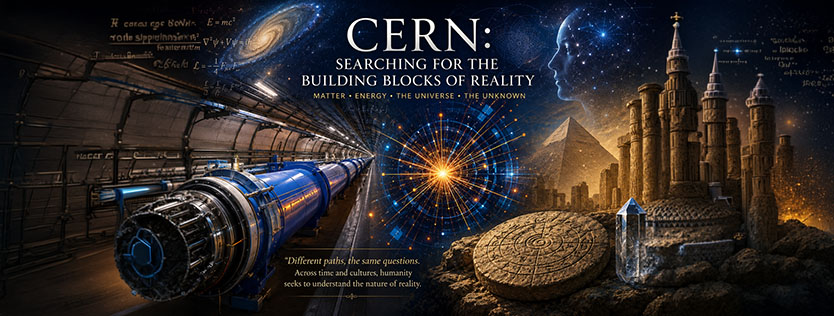
CERN: Searching for the Building Blocks of Reality
Shared from Mu the Motherland
For thousands of years humanity has searched for the hidden principles that govern the universe. Ancient civilizations looked toward the stars, sacred geometry, sound, and philosophy. Today, scientists build enormous particle accelerators to ask many of the same fundamental questions. Although particle physics may seem far removed from everyday life, discoveries made at CERN, the European Organization for Nuclear Research, have already contributed to advances in computing, medical imaging, engineering, and our understanding of the universe.
In previous discussions we considered the possibility (probability?) that pre-historic civilizations, such as Mu and Atlantis existed as advanced cultures with sophisticated technologies. Their understanding of resonance, natural harmonics, crystal amplifications, acoustics, and Earth’s magnetic properties led them to a higher understanding of the makeup of the universe. Today’s scientists have created huge machines to uncover the same knowledge, with the same intention, but along a different path.
CERN, has recently shut down its on-site Large Hadron Collider (LHC) for three years. The LHC is the world’s largest and most powerful particle accelerator that pushes protons or ions to near the speed of light. The structure sits in a tunnel 100 meters underground near Geneva, Switzerland. It is being shut down for maintenance, upgrading, and installation work that will prepare the laboratory for the next phase in the exploration of the fundamental laws of nature. As a result, the HiLumi LHC will succeed the current accelerator to increase the luminosity, or in other words, the measurement of collisions between particles. This is done in order to determine how things work at the most microscopic level. By taking subatomic particles (like protons) and forcing them to crash into each other at incredibly high speeds, the hope is to understand how the building blocks of the universe are held together. In layman’s terms—they are breaking things apart in hopes of finding how they work. The questions they are asking are:
- What is matter?
- What is energy?
- How does the universe work?
- What are the smallest building blocks of reality?
Two different approaches: Ancient philosophies centered on life force, universal consciousness, unseen realms and cosmic order. Modern physics looks closely at quantum fields, invisible forces, probability, and spacetime. Different languages, with similar curiosities. Modern science considers resonance, frequency and wave mechanics, while ancient traditions emphasize sacred chanting, harmonic architecture, musical ratios, and ceremonial acoustics. These two approaches do not need to compete, instead they can give humanity more options to explore—maybe even combine intentions. It seems obvious that civilization repeatedly rediscovers the same truths—recycling knowledge by utilizing new tools while pursuing ancient questions. So, once again we ask, “Are we remembering or discovering?” Modern physics explores matter. Ancient wisdom encourages exploration of consciousness—the two do not necessarily contradict and in fact may be complementary ways of understanding reality.
No matter which path is taken, there is no doubt that CERN’s Laboratory for Particle Physics is a fascinating endeavor. One of the research areas is that of the Higgs boson. The definition from Cern’s public website explains that:
“You and everything around you are made of particles. But when the universe began, no particles had mass; they all sped around at the speed of light. Stars, planets and life could only emerge because particles gained their mass from a fundamental field associated with the Higgs boson. The existence of this mass-giving field was confirmed in 2012, when the Higgs boson particle was discovered at CERN.
In our current description of Nature, every particle is a wave in a field. The most familiar example of this is light: light is simultaneously a wave in the electromagnetic field and a stream of particles called photons.
In the Higgs boson’s case, the field came first. The Higgs field was proposed in 1964 as a new kind of field that fills the entire Universe and gives mass to all elementary particles. The Higgs boson is a wave in that field. Its discovery confirms the existence of the Higgs field.”
So, what does this mean? Particles get their mass by interacting with the Higgs field; they do not have a mass of their own.
The stronger a particle interacts with the Higgs field, the heavier the particle ends up being. Photons, for example, do not interact with this field and therefore have no mass. Yet other elementary particles, including electrons, quarks (an elementary particle and a fundamental building block of matter) and bosons (a subatomic particle responsible for giving mass) do interact and hence have a variety of masses. The Higgs boson has no electrical charge and a spin of zero. Scientists now want to know if the Higgs boson gets mass by interacting with itself in some way?
The Higgs boson appears to be part of the answer to why we—and everything we interact with—have mass, feeding our natural human curiosity about our universe and how it evolved. The Higgs boson, also carries with it the popular nickname of the “God particle” because of its ability to create mass. It’s existence could give scientists insights into dark matter or extra dimensions. This research has led to advances in healthcare, aerospace and more. For e in-depth research, and explanations of CERN’s discoveries, check out the public website https://home.cern/.
It is not surprising that CERN’s work has instigated many wild theories and internet myths. One of the most popular is that CERN’s particle smashing has opened portals and that the shutdown is forced to prevent dimensional breaches. We have talked about portals and vortexes in previous Mu the Motherland’ articles and we are fascinated by the possibility that they exist. However, after spending time with CERN’s website, their research is not directed there, and extensive safety rules are in place.
An area that, if you’re reading this, is one where you can relate, is how the World Wide Web was invented at CERN by a British scientist, Tim Berners-Lee. The web was originally conceived and developed to meet the demand for automated information-sharing between scientists in universities and institutes around the world. On April 30, 1993, CERN put the World Wide Web software in the public domain. Later, CERN made a release available with an open license, a surer way to maximize its dissemination. These actions allowed the web to flourish and for that we are grateful.
Our mission at Mu the Motherland is evolving daily. We continue to investigate both archaeological discoveries, ancient theories and techniques in combination with modern science. We follow the space program at the same time we explore spirituality and the soul’s evolution. We do not see these approaches as contradictory. Instead, we embrace cultural evolution and respect humankind’s free will to grow in love. Whether Mu and Atlantis were historical civilizations, symbolic memories, or enduring legends, they represent humanity’s longing to understand the deepest mysteries of existence. CERN reflects that same spirit of inquiry through modern science, using powerful instruments to probe the smallest constituents of matter. Ancient traditions approached these mysteries through philosophy, observation, and spiritual practice. Although their methods differ, both invite us to ask enduring questions about the universe, our place within it, and the unseen principles that shape reality. Perhaps the greatest discovery is not that one path is right and the other wrong, but that curiosity itself has always been one of humanity’s greatest strengths.
Go in peace.
